Showing posts with label Women in Film. Show all posts

Saturday, 8 June 2013

Disney and the Bechdel Test

For those who don't know the Bechdel test is used to critique Film, TV and other media in regards to it's female characters. It has three requirements :

1) Have two named female characters
2) They have a conversation
3) The conversation isn't about men

My new favourite blog Disney with a Splash of Feminism applies the Bechdel test to all the Disney princess films and her results are well worth a look!

From here

Friday, 7 June 2013

What is it about brutally murdered young women?

(Spoilers for Dexter and The Dark Knight below)

Sady Doyle tries to answer that question with this article titled "The Violently Killed Femmes".

It comes down to the vulnerability that we perceive in a young (almost always white) woman with an air or innocence and virginity. In many shows it transpires that this may not be the whole truth. Twin Peaks' Laura Palmer is a typical example of this, the prom queen who snorts coke and hangs out with demons. Nonetheless she is a complex and ultimately sympathetic character, especially compared to other examples where the dead body is there to be both mourned and fetishised in equal measure.


Thursday, 23 May 2013

Merits of other Disney Princesses

I love the Disney Princesses, my favourite was always Ariel and I wrote a short while back about the controversy that erupted when Disney did a frankly horrible redesign of Merida from Brave.

However I do want to make it clear that, as I mentioned with Belle from Beauty and the Beast, some of the later Disney Princesses do go beyond the "Princess Classic" character type. My, and others', issue is how these three dimensional characters are reduced to their looks alone in the name of merchandising.

The F Word featured an awesome article by Beth Startin that articulates this way better than I ever could. Go read!

Wednesday, 22 May 2013

Star Trek 2: Damon Lindelof responds to controversy

I am seeing the new Star Trek film tonight so I get to see the scene for myself. For those of you who haven't caught it there has been controversy over the allegedly sexist representation of Alice Eve's character been stared at as she gets changed into bomb disposal gear.

More here

To be fair to Lindelof he hasn't brush off the criticism and has made the effort to address concerns via twitter however like I said I haven't seen the scene so I can't comment yet but at any rate it is good to see misogyny in movies being discussed.

Wednesday, 15 May 2013

Disney do it again

And by "It" I mean hyper sexualise one of its female characters and send a bad message to young girls watching.

Disney have sexed up Merida, the protagonist of Pixar's Brave in an attempt to sell more merchandise:

Picture from here
Yeah, it is in no way creepy at all. Let's not forget the character is only about sixteen to boot. Disney have a long standing tradition of vamping up its leading ladies in a perverse attempt to appeal to an audience of young girls. A petition has been launched to change the character design back to it's original form stating:

"The redesign of Merida in advance of her official induction to the Disney Princess collection does a tremendous disservice to the millions of children for whom Merida is an empowering role model who speaks to girls' capacity to be change agents in the world rather than just trophies to be admired. Moreover, by making her skinnier, sexier and more mature in appearance, you are sending a message to girls that the original, realistic, teenage-appearing version of Merida is inferior; that for girls and women to have value – to be recognised as true princesses – they must conform to a narrow definition of beauty."
While Brenda Chapman who designed the character said:

When little girls say they like it because it's more sparkly, that's all fine and good but, subconsciously, they are soaking in the sexy 'come-hither' look and the skinny aspect of the new version. It's horrible!

From here 

The redesign takes away everything that was endearing about the character in the first place. It was refreshing to see a female character who could hold her own and had skills beyond being able to charm animals into doing household chores for her with her singing voice (not that that doesn't have it's uses). In the same way Belle from Beauty and the Beast was refreshing because she was more interested in reading and learning than finding a husband, Merida had a totally different set of priorities and the entire point of the film was her fighting for the right to her independence and the right to marry whoever she chooses or to not mary at all.

Read this article over at Hello Giggles for more!

Monday, 29 April 2013

Following on from yesterday...

This Hello Giggles article carries on the discussion of age gaps between leading men and their lover interests:

Will Smith, George Clooney, Brad Pitt, Denzel Washington and Robert Downey, are all either in their fifties, or rapidly approaching the big five-oh (except Denzel – he’s almost 60!) and these A-List actors seem to always be set up with actresses much younger than they are in almost every single film.

Sunday, 28 April 2013

Leading Men Age, But Their Love Interests Don’t

Kyle Buchanan has written a great piece over at Vulture.com about the age gaps between Hollywood leading men and their love interests. Plus it is jam packed with awesome graphs to look at.

Article here

With the exception of Tom Hanks, all the other actors profiled are significantly older than their love interests. It is borderline dangerous in Hollywood to be an "older" woman but the same can't be said for their male counterparts. Is the industry under the impression that we don't want to see older women on our screens? That we are somehow offended by this notion but seeing an actor doing a love scene with an actress twenty or so years younger is completely fine? I don't have anything against age gaps but they are disproportionately represented in Hollywood, to the extent that the "older woman" seems to be an endangered species.

Saturday, 27 April 2013

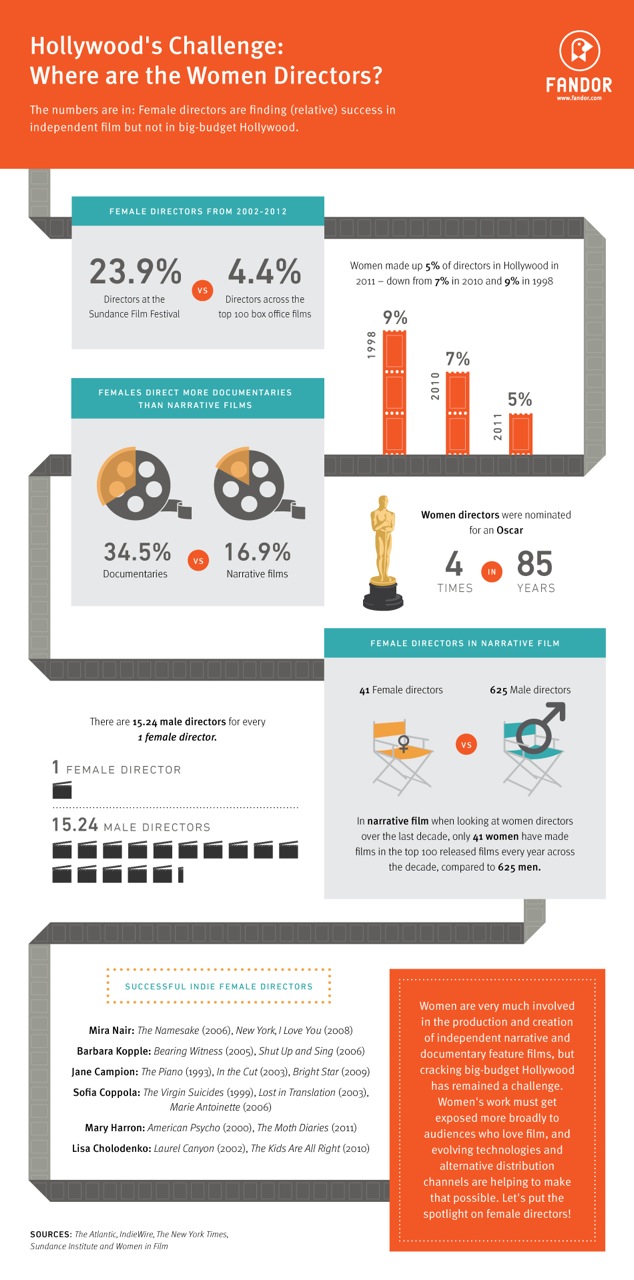
Women and Hollywood Infographic

If you read my Women in Film series over at Yellow Bunting then you'll remember how a recurring theme was how prevalent women were as creators in various eras of movie history. Fandor (a movie streaming site) has created an interesting info graphic to demonstrate this, I found it on Indie Wire:

From here

Friday, 12 April 2013

Writersroom on writing good female characters

When Joss Whedon was asked why he kept writing strong female characters, he (supposedly) replied "Because you keep asking that question"

Over at the BBC Writersroom blog they have an ace article on writing good female characters. It's worth a read.

Wednesday, 10 April 2013

The Sole Defining Feature

Cross posted from Yellow Bunting:


If you haven’t been watching channel four’s new show Gogglebox, it basically follows a cross section of people sitting and watching television. That’s right, it’s you sitting and watching people watching TV.
It is fairly funny but I have noticed something that has been bugging me, particularly in the most recent episode. It showed the people featured watching two shows, one with Dr Margaret Mountford (formerly of the apprentice)exploring the ruins of Pompeii and the other with Dr Joann Fletcher showing us how everyday people lived in Ancient Egypt. Both were shows presented by highly intelligent, passionate presenters that aimed to make the information accessible and interesting for the audience.
So why was it that all the people featured in Gogglebox could focus on was their physical appearance? Not only that but most of their comments were negative, rude and of no direct intelligence to what they were watching.
While I suspect that one of the primary motivations behind Gogglebox is for us to be able to laugh at the viewers featured (the posh alcoholic couple, the woman with the obnoxious children etc.) it does highlight a problem for women who work on that side of the media.
A while back I wrote a post on Anita Sarkessian, a media commentator and presenter of her own web-based show, Feminist Frequency. Sarkessian is all kinds of awesome but was the target of vile, sexist abuse when she tried to crowd fund her latest project.
Similarly, last year when Mary Beard was subjected to similar abuse (and threats of violence) after appearing on Question Time, she remarked that it was enough to put any women off of appearing on TV.
I’m sure I don’t need to go into why that’s bad.
By virtue of making up more than half the population of the earth, we are entitled to have smart, passionate women on television communicating their ideas but when they are reduced to the sole function of being a thing to look at, devoid of any personality or worth beyond the aesthetic, why on earth would anyone want to subject themselves to that?
It’s not clear whether most of these detractors are men or women in fairness (before I’m being accused of being a man hater) and plenty of the viewers onGogglebox were women, so as a general audience we need to readjust our viewing habits and expectations for the media and perhaps we can take these programmes for what they are: entertaining, informative and presented by smart, charismatic women to make us want to learn more.


Saturday, 9 March 2013

Must read article

I found this interesting article by Sasha Weiss at The New Yorker entitled "Anne Hathaway: In defence of the happy girl".

It is well worth a read and offers an interesting perspective on how we view women in the limelight.

Thursday, 7 February 2013

For Your Consideration

Cross posted from Yellow Bunting


Awards season is upon us and as every film geek knows it is a grand celebration of all the achievements made in Western (okay mostly American) film over the past twelve months. Saying that, it’s also a chance for every aforementioned film geek plus critics and casual observers to gripe and whine about the various “snubs” and omissions and for the nausea inducing, sycophantic interviews that forms half all of the multi channel coverage, the other half being those horrific “let’s rip into these otherwise successful and beautiful women by making offensive comments about their appearance” shows.

I have a love/hate relationship with awards shows. On the one hand gets everyone talking about films and I have to own up to enjoying my fair share of glitz and glamour. On the other hand it gets people whinging about films and the complaints over who has been omitted can overshadow the glory of those who win.

The best example of this is how the word “snub” becomes the buzzword on everybody’s lips as soon as the first batch of nominations are out.


There is always outrage that XYZ didn’t make it in or if Film A was nominated why wasn’t the guy who directed it? This year for example, Skyfall didn’t receive any Oscar nominations for its lead actor or director and wasn’t nominated for best picture.  Even at our own BAFTAs Skyfall is trailing behind Lincoln (which hasn’t even been released in the UK yet, much to the consternation of many British film goers) which got 10 nominations. Director Steven Spielberg has been “snubbed” by both BAFTA and the Academy who have both left him out of the lists for Best Director. Add into the mix the same arguments about animation and foreign film that come back year after year and you start to wonder why anyone bothers. Of course money plays a huge part as does ego and the fact that many awards and nominations are politically motivated but there is also the fact that these are good films.


It isn’t helpful to dwell on the negatives and flinging the word “snub” around just diminishes the achievements made by those who did make it in to the nominations. So I for one resolve this year to approach awards season with an open mind and view it as a way to be introduced to new films and discovered new, thoroughly deserving, talent.

Full list of Academy Award nominees here
Full list of BAFTA nominees here

Saturday, 15 December 2012

Movie Making Madames Part Five: Ida Lupino and Dorothy Arzner


The prevalence of women as content makers in the film industry, particularly in Hollywood, dropped dramatically after the advent of sound and the realisation that movies were big business. While women thrived in the avant-garde, at this point in Hollywood there were only two active female directors after the “talkies”, Dorothy Arzner and Ida Lupino. Arzer worked from the introduction of sound in the 1920s to the early 1940s while Lupino was only only female film director of the 1950s.
LA born Dorothy Arzner originally wanted to be a doctor but after visiting a movie studio shortly after the end of WWI she set her heart on becoming a director. She would go on to become one of the most formidable and respected women to work behind the camera.
Dorothy worked her way up from the bottom before being promoted to a role as a film editor, a highly specialised and intricate job in the days of celluloid. The movies she worked on were huge successes and Dorothy used her new found clout to land a directing job. But it couldn’t be any old flick, Dorothy (or Ms. Arzner as she would insist on being called on set) wouldn’t direct anything less than an A-picture. Back in those days films were often run in double bills with newsreels and shorts so you could spend a whole afternoon at a cinema. The two films were the A-picture, (higher budget and more prestigious) and the B-picture (a cheaper, quicker flick). The B-Movie just wasn’t an option for Arzner and her first film Fashions for Women in 1927, was a commercial success.

Alongside this Arzner was also an innovator. While directing Clara Bow’s first sound film, Arner told a sound operator to attach the microphone for the shoot to a fishing pole so she could follow the actress round the set who now had freedom of movement. This handy piece of equipment, the mike boom, is a staple of any filmmaker’s kit today.


Most of her films centred around strong women and Arzner flourished before the introduction of the Hay’s code, industry imposed measured to curb “risqué” content in Hollywood films. Arzner worked with some of the greatest actresses of her time and was well known for having affairs with many of them.  Her work led Arzner to be the first woman to be inducted into the Director’s Guild of America and it earned her a star on the Hollywood Walk of Fame. She retired from directing in the mid forties but spent the rest of her life passing on her skills as a writer and director by teaching at the UCLA film school.
Ida Lupino was a British born actress from a show business family.  While she was respected as an actress she was referred to as “the poor man’s Bette Davis” for accepting many parts that Davis turned down. She was still well known for defying the studios and raising hell and during suspension for refusing a role, Lupino became interested in the process behind the camera.  Her enthusiasm grew and Lupino and her husband started their own production company where Lupino wrote and produced some of her films. In 1949 Lupino directed her first film to great acclaim though she didn’t take credit having only slipped into the role when her predecessor suffered a heart attack.

Lupino’s films as a director were similar to her films as an actress: highly moralistic, low budget and concerned with the truth however unpleasant. Often her films looked at “women’s issues” offering a unique perspective that no one else in Hollywood could give at the time but she also became the first woman to direct film noir with The Hitch-hiker in 1953:


Interestingly the film features and all male cast and though the studio was keen to play up the success of the lone female director, it was at Lupino’s insistence that they also stress her femininity so she wouldn’t seem threatening to the men she worked with.  In later life she made the transition to the new medium of television and directed 50 separate episodes of various programmes. For her efforts her adopted country awarded her two stars on the Hollywood Walk of Fame, one for services to film and the other to services to television.
Next week sees the final part of the series with the modern female filmmakers rising to prominence.
Cross posted from Yellow Bunting. Sorry its a bit late. It actually went out before the Perks podcast.

Wednesday, 28 November 2012

Movie Making Madames Part Four

Sometimes it can seem like all the films being churned out are either remakes or sequels. Hollywood can seem formulaic and narratively simplistic. Ever since movies began there have always been people who have wanted to try something different and so the independent film industry was born. It lacked the money and influence of mainstream film industries but it made up for that with maverick ideas and inventive ways of bringing them to life.
germaine_dulac.jpg
Picture from here 
Germaine Dulac did a bit of everything. She started her career as a feminist journalist before pursuing her passion for still photography that propelled her on to working as a film director, writer, producer and theorist as well as becoming the president of Fédération des ciné-clubs, a group dedicated to promoting up and coming filmmakers and teaching photography and film, putting many of her contemporary counterparts to shame.
Dabbling in both Impressionism and Surrealism, Dulac’s big successes in cinema such as The Seashell and the Clergyman and The Smiling Madam Beudet came before the advent of sound cinema and before Luis Buñuel and Salvador Dali’sUn Chien Andalou, arguably the most famous Surrealist film ever (If you’ve never heard of it is the film where Buñuel slices a woman’s eye open, it turns into the moon and he and Dali are monks… watch it).


After the introduction of sound Dulac’s career faltered and she spent the rest of her life making newsreels for Pathe and Gaumont. When she died it took three weeks and numerous re-writes before her obituary to be published, she was so controversial.
In the US, Maya Deren is the Grandmother of Indie film and the experimental director Stan Brakhage called her “the mother of us all”, “Us” being everyone who felt like giving the finger at narrative and stylistic conventions.
maya-deren-meshes-of-the-afternoon-1943.jpg
Image from here
I first encountered Maya Deren during my second year of university when our class was shown arguably two of her most famous short films, Meshes of the Afternoon (1943), which I later based my first solo project on and At Land (1944). Art films and experimental films usually get a bad rap outside of hard core film theorist circles because it can look like jumbled mess and overly pretentious. Deren thought of her films as visual poems, capturing fleeting emotions and states of being rather than events or characters. The films rely on striking images and haunting concepts to draw in the audience. Deren acted in her films but never credited herself, preferring to keep her characters as anonymous figures and her film crews were similarly simplistic. Deren worked on Meshes with only her second husband Alexander Hammid and a 16mm camera bought using inheritance money. Deren once claimed that “I make my pictures for what Hollywood spends on lipstick” and she was a fierce critic of the way she felt Hollywood was stifling creativity and diversity within American Cinema.


Tragically, Deren died in 1961 from malnutrition, possibly due to her drug use. A posthumous documentary was released in 1985 from footage Deren shot between 1947 and 1951 when she made multiple trips to Haiti. Divine Horsemen: the Living God’s of Haiti (1985) led to some criticizing Deren for leaving the avant-garde but Deren herself felt she needed to progress as an artist and Vodun traditions and rituals were fascinating to her. Her book of the same name is considered an important text on the subject. Sadly, Deren never completed the project and the last film released before she died, The Very Eye of Night (1958) gives us a glimpse at how her work could have unfolded.


Life (especially work) has been a bit manic of late hence why there has been so little posting. My apologies for that and I can only say that things should become more regular after the christmas period!